Grief Quotes for the Loss of a Mother: Missing Mom, Always
Losing your mother is a particular kind of grief. She is, for most of us, the first home we ever knew — the person who was simply there before memory begins. When she dies, people often say they feel orphaned at forty, at sixty, at any age, and they are right: there is no other loss quite like it, because there was never another relationship like it. The quotes below are the ones families actually reach for — each checked against its source, because on this site a quote is only published with the name we verified it against.
Quotes that say what you feel
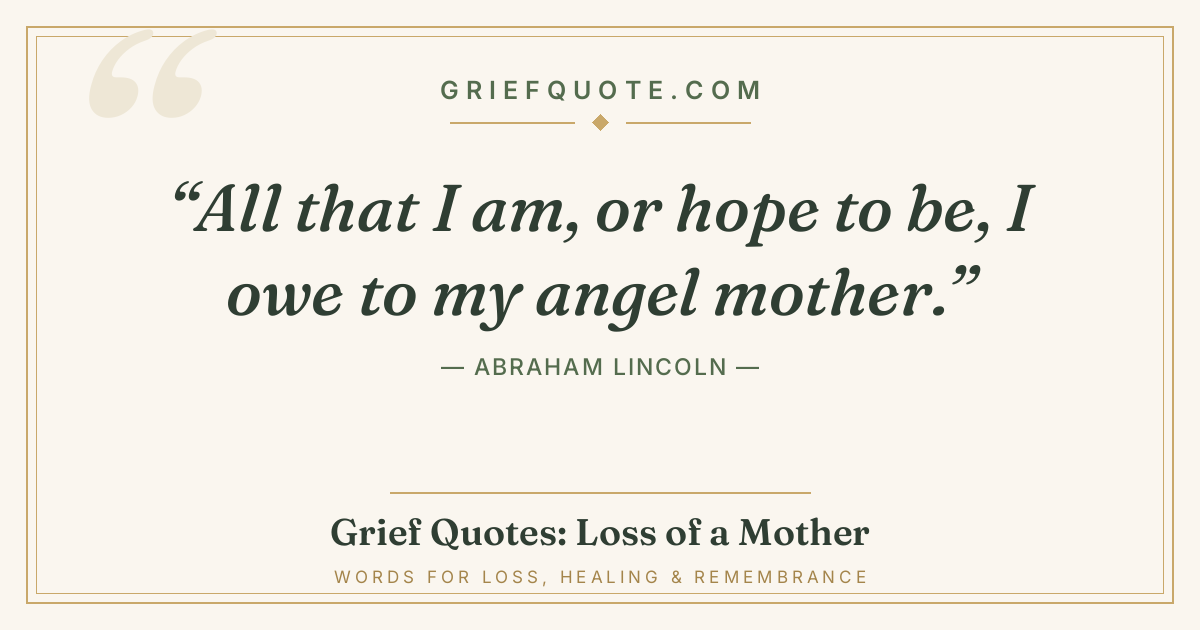
“All that I am, or hope to be, I owe to my angel mother.” — Abraham Lincoln, on his mother Nancy Hanks Lincoln, who died when he was nine. Perhaps the most quoted sentence ever written about a mother, and it has only grown truer for the people who read it at a funeral.
“A mother is the truest friend we have, when trials heavy and sudden fall upon us.” — Washington Irving, The Sketch Book. Irving’s mothers are the ones who stay when the fair-weather friends of prosperity have gone — which is exactly why her absence is felt in every hard week that follows.
“Mothers hold their children’s hands for a short while, but their hearts forever.” — Anonymous. The author of this funeral favourite is unknown, and any site that gives you a name for it is guessing. What is certain is why it endures: the holding changes, it does not end.
“Motherhood: All love begins and ends there.” — attributed to Robert Browning. A whole theology of mothers in eight words: the first love we know, and the standard every later love is quietly measured against.
“A mother’s arms are made of tenderness, and children sleep soundly in them.” — Victor Hugo. For many grown children, the grief is precisely this: the safest place in the world is no longer somewhere you can go.
“When you look into your mother’s eyes, you know that is the purest love you can find on this earth.” — Mitch Albom, For One More Day, a novel about a son granted one more day with his late mother — which is, of course, the day every grieving son and daughter wishes for.
“As a mother comforts her child, so will I comfort you.” — Isaiah 66:13. Scripture reaches for a mother when it wants an image of comfort itself. If your faith is part of your grief, our Bible verses for grief page gathers more.
From the poets: two short excerpts
Ann Taylor, “My Mother” (1804) — one of the oldest mother poems in English, learned by generations of children:
“Who sat and watched my infant head, / When sleeping on my cradle bed…”
Rudyard Kipling, “Mother o’ Mine”:
“If I were hanged on the highest hill, / Mother o’ mine, O mother o’ mine! / I know whose love would follow me still…”
Both poems are shown as excerpts, as all poems are on this site — the full texts are easy to find, and both are worth reading whole at her graveside or on a quiet evening. More in our grief poems collection.
What to write in a card for someone who lost their mother
Knowing she mattered is what the bereaved need to hear — specifically, not generally. The formula that works: name her, name one true thing about her, and make one real offer.
- “I was so sorry to hear about your mom. I still think about her kitchen-table advice the night before my wedding — she had a way of making hard things feel doable. I’m bringing dinner Thursday; no need to reply.”
- “Your mother raised the kindest person I know, and I see her in you constantly. I’m here — this week, and in six months when everyone else has gone quiet.”
- If you never met her: “I didn’t know your mom, but I know what she made. I’d love to hear about her whenever you want to talk.”
Our sympathy card quotes page has the full two-minute formula and more copy-paste messages, and what to say to a grieving friend covers the conversations after the card.
Mother’s Day, her birthday, and the other hard dates
The first year is a calendar of ambushes: her birthday, your birthday (the calls that don’t come), Mother’s Day above all. A few things people who have been through it say helped:
- Decide the day before it arrives. Visit her grave, cook her signature dish, or deliberately do nothing — all are fine. What hurts most is being ambushed by a day you pretended wasn’t coming.
- Write her a letter. Unsent, unposted, entirely yours. Many people keep one letter a year in the same notebook.
- Let the day be about her, briefly and on purpose — light the candle, say the name — and then let it be an ordinary day too. Grief that is given a time and place tends to ambush less.
- If you are supporting someone else: a message on the day itself (“Thinking of you and your mom today”) costs thirty seconds and is remembered for years.
More on getting through the calendar in coping with death and healing grief quotes.
A note on sources
Lincoln’s and Irving’s lines are quoted from their standard published sources; the Browning line is widely attributed and labelled as such; the “hands for a short while” saying is honestly Anonymous. Where a line’s origin cannot be verified, this site says so rather than borrowing a famous name — the full policy is on our About page.
Keep reading
- Grief Quotes for the Loss of a Child — for bereaved parents
- Grief Quotes for the Loss of a Father — the companion page in this series
- Grief Quotes for Losing a Husband or Wife — when your person is gone
- Family Grief Quotes — words for losing any close family member
- Missing You Grief Quotes — for the days it still hurts
- Healing Grief Quotes — gentle words for the road back
- Grief Poems & Poetry Quotes — verses for funerals and quiet days
- Death Anniversary Quotes — remembering them, every year
- Grief at Christmas — coping when someone is missing
Frequently asked questions
What is a good short quote for a mother’s funeral? Lincoln’s “All that I am, or hope to be, I owe to my angel mother” is the most used, and with reason. For programmes and headstones, the Anonymous line “Mothers hold their children’s hands for a short while, but their hearts forever” is the other classic.
Why does losing my mother feel different from other losses? Because she was usually your first attachment — the relationship predates your memory. Therapists who work with bereaved adults note that mother loss can unsettle identity itself (“I am no one’s child now”), which is why it can feel destabilising in a way other griefs do not.
What should I say to a friend whose mom died? Name her and be specific: one memory, one quality, one concrete offer of help. Avoid “she’s in a better place” and “stay strong” — our friend page lists what to say instead, word for word.
Does the grief for a mother ever go away? It changes rather than ends. Most people find the sharp pain softens into something carried — present on anniversaries and in quiet moments, woven into who they are. If grief is instead getting heavier, or daily life has stopped working, a bereavement counsellor is a real and worthwhile step, not a last resort.

3 Comments