Death Anniversary Quotes: Remembering Them, Every Year
A death anniversary is the date the calendar keeps for you. Other people need reminding; you never do — your body starts counting down weeks before, in a heaviness you can’t always explain until you look at the date. Whether this is the first anniversary or the twentieth, whether the day ambushes you or you plan for it like a military operation, you are in very large company: nearly everyone who has loved and lost someone knows this date in their bones. The words below are the ones people actually use on this day — each checked against its source, as every quote on this site is.
Quotes for the anniversary of a death
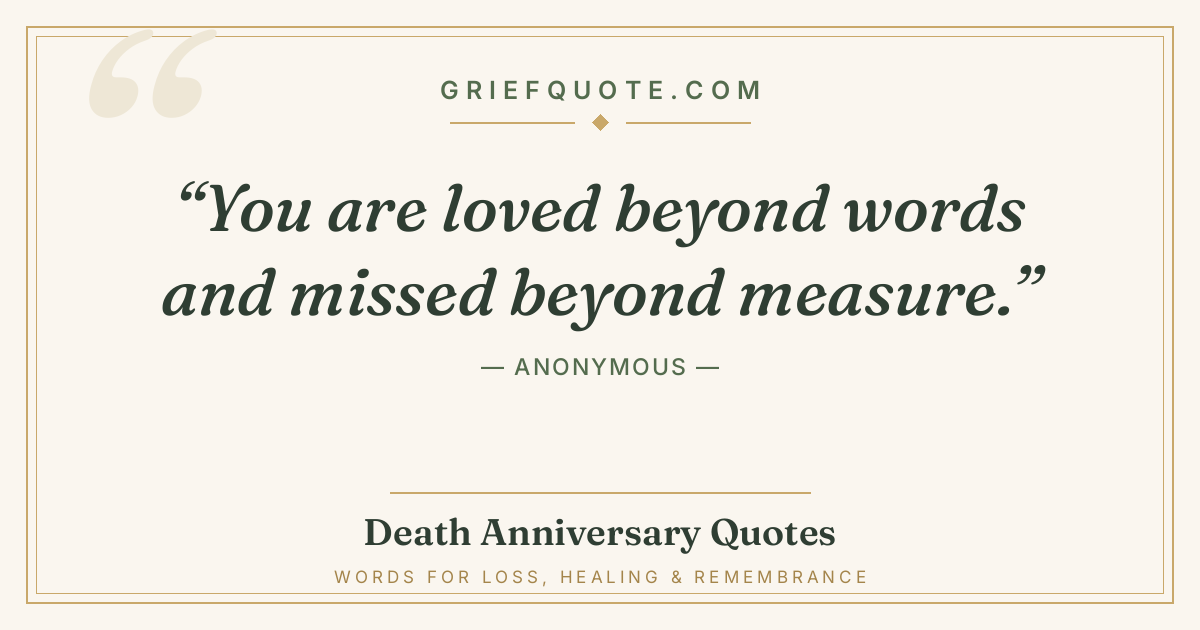
“Your life was a blessing, your memory a treasure. You are loved beyond words and missed beyond measure.” — Anonymous. The most-used death anniversary verse in the English-speaking world, found on memorial cards and headstones everywhere; its author is unknown, and any site that names one is guessing.
“Unable are the Loved to die, for Love is Immortality.” — Emily Dickinson. Two lines from a poem (numbered 809 in her collected works) that anniversaries seem designed to prove: the love did not attend the funeral and leave. It stayed, and it is still here on this date, doing its work.
“Because someone we love is in heaven, there is a little bit of heaven in our home.” — Anonymous, a traditional saying on anniversary cards for generations. It captures the strange double truth of the day: the house is emptier, and somehow also visited.
“Time is too slow for those who wait, too swift for those who fear, too long for those who grieve, too short for those who rejoice — but for those who love, time is eternity.” — Henry Van Dyke, from his poem “Time Is”. On an anniversary both halves are true at once: the year crawled, and it flew, and the person is exactly as gone and exactly as loved as on the first day.
“Say not in grief ‘he is no more,’ but in thankfulness that he was.” — a Hebrew proverb, quoted at memorials for centuries. The anniversary, at its best, is the day grief makes room for this: not moving on, but giving thanks in the same breath as the missing.
The first anniversary — and the ones after
The first anniversary carries a particular weight: it closes the year of firsts, and many people are surprised to find it is not the worst day of the year — the ordinary Tuesdays of year one were worse, because the anniversary at least arrives expected, with permission to grieve attached. What people further along report: the date stays significant but changes texture — less ambush, more appointment. Later anniversaries can ambush harder than early ones precisely because you stopped bracing for them; year seven’s wave is not a relapse, it is the price of having relaxed. And the anniversary effect is real and physical — poor sleep, heaviness, irritability in the days around the date, even years later, even when you’d “forgotten”. You hadn’t. Your body keeps the calendar even when your mind lets it go.
What to write to someone on the anniversary of a death
This is the message almost everyone means to send and almost nobody does — which is why the person who sends it is remembered for years. The formula: their person’s name, the date acknowledged plainly, one line of memory or love, no advice.
- “Thinking of you today, and of Martin. Two years and his laugh is still the first thing I hear when I think of that summer. No need to reply — just wanted you to know he’s remembered here too.”
- “I know what today is. I set a reminder because I didn’t want it to pass in silence for you. She’s missed, and so is the you that you were with her. Here, always.”
- On a card or flowers: “In memory of Sarah — [date] — loved beyond words, missed beyond measure.” (The Anonymous verse above exists precisely for this.)
The friend who texts on the anniversary is doing the single most valued thing in all of bereavement support, because anniversaries are when the grieving feel most alone with a date the rest of the world has stopped seeing. Our sympathy card quotes page has more wording you can copy.
Ways to mark the day
There is no liturgy you owe anyone, but people who mark anniversaries deliberately say it helps to give the day a shape: visit the place — grave, scattering site, or simply their bench, their café, their street. Light a candle — the Jewish tradition of Yahrzeit has done this for centuries: a candle lit at sunset that burns for the full day of the anniversary, a small visible flame for an invisible presence. Do their thing — cook the dish, play the music, make the donation in their name. Write the letter — one a year, telling them what the year held; many families keep them in the same drawer, growing into a strange and precious archive. Or let it be ordinary — some years, the bravest marking is a normal day, and that too is a form of love that has learned to carry itself quietly. You can choose differently every year. Most people do.
A note on sources
Dickinson’s and Van Dyke’s lines are from their published poems; the “loved beyond words” verse and the “little bit of heaven” saying are honestly Anonymous and traditional; the Hebrew proverb is presented as exactly that. On this site, the name under a quote is a promise — the full policy is on our About page.
Keep reading
- Grief Quotes for the Loss of a Child — for bereaved parents, on this date and every date
- Missing You Grief Quotes — for the days it still hurts
- Healing Grief Quotes — gentle words for the road back
- Grief Poems & Poetry Quotes — verses for anniversaries and quiet days
Frequently asked questions
What is the anniversary of a death called? Simply a “death anniversary”. In the Jewish tradition it is Yahrzeit, marked with a 24-hour candle and prayers. In baby-loss communities, parents often say “angelversary”. There is no formal English word — which says something about how privately this day is usually carried.
What do you write on a death anniversary card? Their name, the fact that you remembered the date, and one true line — a memory, a quality, or the Anonymous verse “loved beyond words, missed beyond measure”. Short and specific beats long and general, every time.
Is it normal for the anniversary to hurt years later? Completely. The “anniversary reaction” — heaviness, tears, poor sleep around the date — is documented in bereavement research and reported by people decades out. It is not a setback and it is not you failing to heal; it is the calendar touching the place where they are kept.
Should I acknowledge the anniversary, or will it upset them? Acknowledge it. The fear of “reminding” them rests on a fiction — they have never forgotten, and the date has been approaching in their body for weeks. A short message tells them they are not carrying the date alone.
2 Comments