Grief Quotes for the Loss of a Child: For Bereaved Parents
This is the loss that breaks the order of things. Parents are not supposed to bury their children, and no quote on this page — or anywhere — will make that acceptable. What words can do, at their best, is smaller and more honest: tell a bereaved parent that their child is not forgotten, that their grief is not too much, and that they do not have to tidy it away for anyone. That includes parents whose child died before birth, in childhood, or as an adult — a parent who outlives their child carries this grief at every age, and this page is for all of them. Every line below is checked against its source, as every quote on this site is.
Quotes that say what you feel
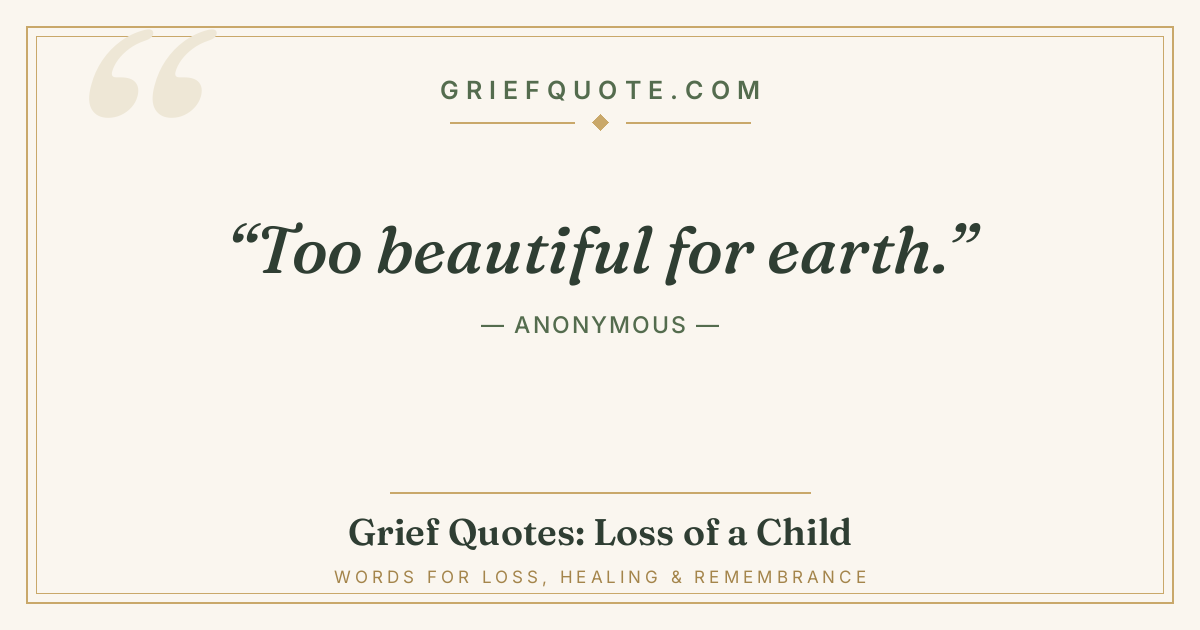
“An angel in the Book of Life wrote down my baby’s birth. Then whispered as she closed the book: ‘Too beautiful for earth.'” — Anonymous. The author is unknown, and it may be the most-shared verse in the whole literature of child loss — written on cards, read at tiny funerals, held onto by parents for decades.
“What we have once enjoyed deeply we can never lose. All that we love deeply becomes a part of us.” — Helen Keller. Keller, who lost neither sight nor hearing’s worth of inner life, understood the permanence of love better than most: what was loved is not confiscated by death. It changes address; it does not end.
“Children are the hands by which we take hold of heaven.” — attributed to Henry Ward Beecher, the American preacher. It is why the loss feels the way it does: heaven was, in some real sense, already in the house.
“Let the little children come to me, and do not hinder them, for the kingdom of heaven belongs to such as these.” — Jesus, in Matthew 19:14. For Christian parents this is the verse returned to most: their child is not lost in transit. He is with the one who asked for him by name. More in our Bible verses for grief.
From a poem — Victor Hugo, who lost his daughter Léopoldine at nineteen and wrote “Demain, dès l’aube” (“Tomorrow, at Dawn”) about walking to her grave:
“Tomorrow, at dawn, when the countryside brightens,
I will leave. You see, I know that you are waiting for me.”
Shown in translation and as an excerpt, as all poems are here. Hugo made that walk for years. Parents who read him feel recognised: the journey to the grave is not morbid; it is an appointment love keeps.
What this grief actually looks like
Well-meaning people expect grief to shrink over time. Bereaved parents describe something different, and a widely used model in bereavement care (from counsellor Lois Tonkin) puts it exactly: the grief does not shrink — your life slowly grows around it. The ball of grief stays its size; the container gets bigger. Parents also describe: milestones that never happen — the first day of school, the graduation year, the wedding that should have been — arriving in other families’ photos while their own child stays the same age forever. Being a parent in the present tense. A mother who lost her only child is still a mother. A father is still a father. Nothing about the death revokes the job title. And grief in two directions at once — for the child who was, and for the adult they never got to become. If you recognise all of this, you are not grieving wrong. You are grieving a child, which is simply this heavy.
The most important thing anyone can do: say their name
Ask bereaved parents what they fear most and the answer is rarely the pain — it is that the world will stop saying their child’s name. Friends avoid the name thinking it will hurt; parents will tell you the opposite: hearing the name is the gift, because it proves the child existed to other people too. So say it. “I was thinking of Emma today — she would have been starting Year 6.” “This song was playing and I thought of Jacob.” Thirty seconds, remembered for years. If you remember one thing from this page, make it this.
What to say to a parent who lost a child — and what never to say
Say:
- “I don’t know what to say, and I’m not going anywhere.” Presence beats eloquence at every stage.
- “Tell me about her.” Most parents are waiting for someone brave enough to ask.
- Her or his name, on their birthday, on the anniversary, and on ordinary Tuesdays.
Never say:
- “You’re young — you can have another.” A child is not a replaceable object, and no parent has ever been comforted by arithmetic.
- “It was God’s will / everything happens for a reason.” Even when meant kindly, it asks a parent to agree that their child’s death was acceptable. Let them find their own meaning, in their own time.
- “You need to be strong for your other children.” They know. What they need is permission to grieve this child without it being treated as a failure of care for the others.
Our sympathy card quotes page has copy-paste wording, and what to say to a grieving friend covers the months after the funeral.
For the hard dates
Their birthday. The date of death. Mother’s Day and Father’s Day, which now arrive like exams nobody studied for. Other parents’ children reaching the age yours will never reach. What bereaved parents say helps: mark the birthday, somehow — a candle, a donation in their name, a visit, their favourite meal cooked badly and with love. Decide plans before the date ambushes you. And let siblings in — brothers and sisters grieve too, often quietly, often protectively; a ritual the whole family shares gives them somewhere to put it. There is no correct shape to any of this. The only rule that survives contact with real families is that the child is included, not edited out.
A note on sources
The “Book of Life” verse is honestly Anonymous — its author is unknown, whatever other sites claim. Keller’s words are from her published writings; Beecher’s line is widely attributed and labelled as such; Hugo’s poem is in the public domain and shown in a standard translation. On this site, the name under a quote is a promise, and it matters most on this page. The full policy is on our About page.
Keep reading
- Grief Quotes for the Loss of a Mother — words for the other side of this bond
- Grief Quotes for the Loss of a Father — the companion page
- Missing You Grief Quotes — for the days it still hurts
- Healing Grief Quotes — gentle words for the road back
Frequently asked questions
How do I answer “How many children do you have?” There is no rule, and bereaved parents handle it differently on different days. Many include the child who died — “Three: two at home, and one in heaven” — because leaving them out feels worse than the awkward pause. Others keep it simple with strangers to protect themselves. Both are right. It is your child and your sentence.
Does the grief of losing a child ever get better? It changes shape rather than ending. Parents decades out describe it as woven in — no longer the whole fabric, never removed from it. If the grief is getting heavier instead of more bearable, or daily life has stopped functioning, a bereavement counsellor who works specifically with child loss is worth finding; this is the deepest water there is, and nobody should have to swim it unaccompanied.
Is it wrong that I laughed / forgot for an hour? No. Laughter after child loss is not betrayal, and parents who punish themselves for a moment’s lightness make the road longer. Your child knew your laugh. It’s one of the things they loved.
My friend lost her baby before birth. Does this page apply to her? Yes. A child lost in pregnancy or at birth is a child lost — with names chosen, a room imagined, a future already furnished. Parents of babies who died before birth often receive the least support and the most minimising language (“it wasn’t really…”). It was really. Everything on this page is for her too.
4 Comments