Grief at Christmas: Coping When Someone Is Missing
Ask a bereaved person which date they dread and, after the anniversary, most say the same one: Christmas. Not because the day itself is cruel, but because Christmas is made of traditions — and every tradition has their fingerprints on it. The seat at the table. The handwriting on the tags. The carol they always sang too loudly. December surrounds you with evidence of how life looked before, while simultaneously instructing you to be merry. If you are grieving this Christmas — or loving someone who is — this page is for you: honest words, practical permission, and nothing that asks you to perform a feeling you don’t have.
Words for a grief-filled Christmas
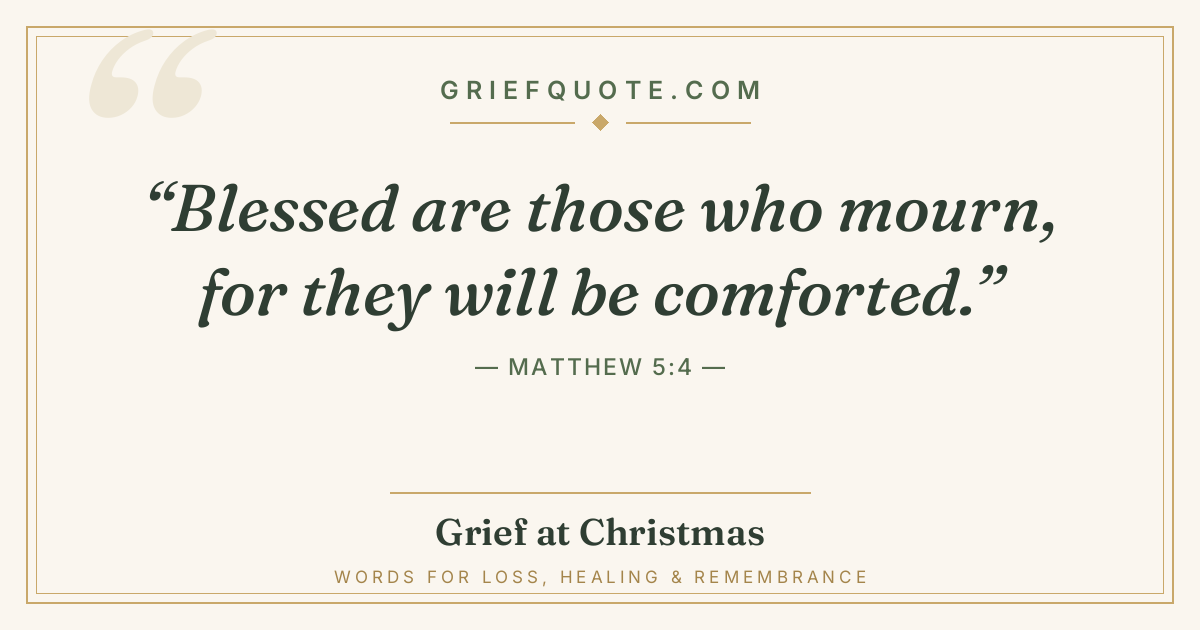
“Blessed are those who mourn, for they will be comforted.” — Matthew 5:4. The season’s own book makes room for mourners at the centre of it; grief at Christmas is not a failure of Christmas spirit. It is written into the story from the beginning — the first Christmas in Matthew’s gospel ends with Rachel “weeping for her children and refusing to be comforted” (Matthew 2:18). Sorrow was there before the tinsel was.
From a poem — Henry Wadsworth Longfellow, “Christmas Bells” (1863), written during the Civil War, two years after his wife died and months after his son was gravely wounded:
“And in despair I bowed my head; / ‘There is no peace on earth,’ I said; / ‘For hate is strong, and mocks the song / Of peace on earth, good-will to men!’”
Shown as an excerpt, as all poems are here. What matters is that Longfellow did not stop there — the poem’s final stanzas answer the despair, as the bells keep ringing: “God is not dead, nor doth He sleep.” A grieving man wrote the carol now known as “I Heard the Bells on Christmas Day”, and he wrote the hopeless verse first. Both halves are allowed.
“Those we love don’t go away; they walk beside us every day.” — Anonymous, a traditional saying carried on Christmas memorial cards for generations. At Christmas it lands differently than in any other month: beside us at the table, the tree, the empty chair.
Why Christmas hurts more — and why that’s normal
Three reasons, all structural rather than personal failure. Ritual density: no other season concentrates so many repeated, dated, sensory rituals into three weeks — each one a comparison against every previous year. The performance gap: Christmas is the one grief season with a dress code for emotion; the demand to be joyful makes ordinary sadness feel like letting everyone down. Anticipation: most bereaved people say the build-up — the adverts starting in November, the first carol in a shop — is harder than the day itself, which arrives with its own numb momentum. Knowing this helps some people plan: the day is 24 hours, it can be survived in pieces, and the pieces can be chosen.
You are allowed to do Christmas differently
Every item on this list has been done by real grieving families without the sky falling: skip it entirely — some years the bravest sentence is “not this year”, and true friends survive hearing it. Shrink it — lunch instead of the full production; four people instead of fourteen. Change the venue — a different house, a restaurant, a trip; new settings carry fewer ghosts. Keep one tradition, drop ten — the candle on the table, the toast in their name — and let the rest go without a committee meeting. Leave early, arrive late, sit in the car for ten minutes. Nobody who loves you is scoring your endurance. And if you find, to your own surprise, that you laugh at lunch and enjoy the pudding — that is allowed too, fully, without guilt. Joy breaking through is not betrayal; it is often the day’s kindest moment, and the person you lost would not begrudge you a second of it.
Keeping them in the room
Most families find the day goes better when the missing person is included deliberately, rather than avoided in a silence everyone can hear: a candle lit on the table or mantel from morning to night. The empty chair kept, or their photo where the cards go — some families set the place; others find the set place too much and keep a candle instead. Both are right. A toast, early in the meal, by name — thirty seconds that license everyone else to mention them all day, which is the real gift: after the toast, their name is back in the room and nobody has to tiptoe. Their story told once, on purpose — the Christmas they ruined the turkey, the present that became legend. Grief handled this way tends to visit at the planned moments instead of ambushing at the crackers.
What to write in a Christmas card to someone who is grieving
The mistake everyone makes is writing the card as if this year were normal — “Have a wonderful Christmas!” lands on a bereaved house like a brick. The fix is one honest sentence:
- “I know this Christmas will be different and hard. I’m thinking of you, and of David — he is missed here too. No need to reply to anything this month.”
- “Wishing you whatever peace this season can hold. Her name came up at our table and we raised a glass. With love, always.”
- If you’re close: “We’re setting a place in our hearts, not just at the table. Come as you are — cheerful, flat, or not at all. The door is the same either way.”
And if you are the bereaved person receiving forty cards that all say merry: you do not have to answer them, match them, or forgive the ones that sting on their authors’ behalf. Put them in a pile. January is soon enough for everything.
Our sympathy card quotes page has more wording you can copy word for word.
A note on sources
Matthew 5:4 and 2:18 are quoted from the Gospel text; Longfellow’s “Christmas Bells” (1863) is in the public domain and shown as a short excerpt from a seven-stanza poem; the “walk beside us” saying is traditional and honestly Anonymous. On this site the name under a quote is a promise — the full policy is on our About page.
Keep reading
- Death Anniversary Quotes — for the other hardest date on the calendar
- Grief Quotes for the Loss of a Child — for bereaved parents facing December
- Missing You Grief Quotes — for the days it still hurts
- Healing Grief Quotes — gentle words for the road back
Frequently asked questions
Is it OK to skip Christmas after a bereavement? Yes — completely, and more common than you think. Grieving people skip, shrink, relocate and redesign Christmas every year. The people who matter will understand; the ones who don’t were asking you to perform, which was never your job.
Should I send a Christmas card to someone who lost a loved one this year? Yes — but write it for the year they actually had. One sentence acknowledging the loss, their person’s name, and no demand for merriment. A card that pretends nothing happened is the only wrong card.
How do I get through Christmas Day itself? In pieces, with exits: decide in advance which parts you’ll attend, give the day one planned moment of remembrance (a candle, a toast, a visit), keep a low-demand refuge (a walk, a room, the car), and let the day end. It is 24 hours; you have survived harder ones.
Why does everyone else seem fine at Christmas? They don’t — they seem it. December is grief’s peak season for thousands of households performing exactly what you’re performing. Some of the merriest people at the table are carrying the same weight you are, with more practice at hiding it.


One Comment