Rumi Grief Quotes: Love, Loss and the Wound Where Light Enters
Rumi — Jalāl al-Dīn Muhammad Rūmī, the 13th-century Persian poet and Sufi mystic — knew grief from the inside. His beloved friend and teacher Shams Tabrizi vanished (almost certainly murdered), and the poetry Rumi wrote out of that loss became some of the most loved verse on earth. His great collection of lyrics is literally named for the lost friend: the Divan of Shams.
Eight centuries later, the bereaved still reach for him — because Rumi never treats grief as the opposite of love. He treats it as love, continuing.
Rumi on loss and separation
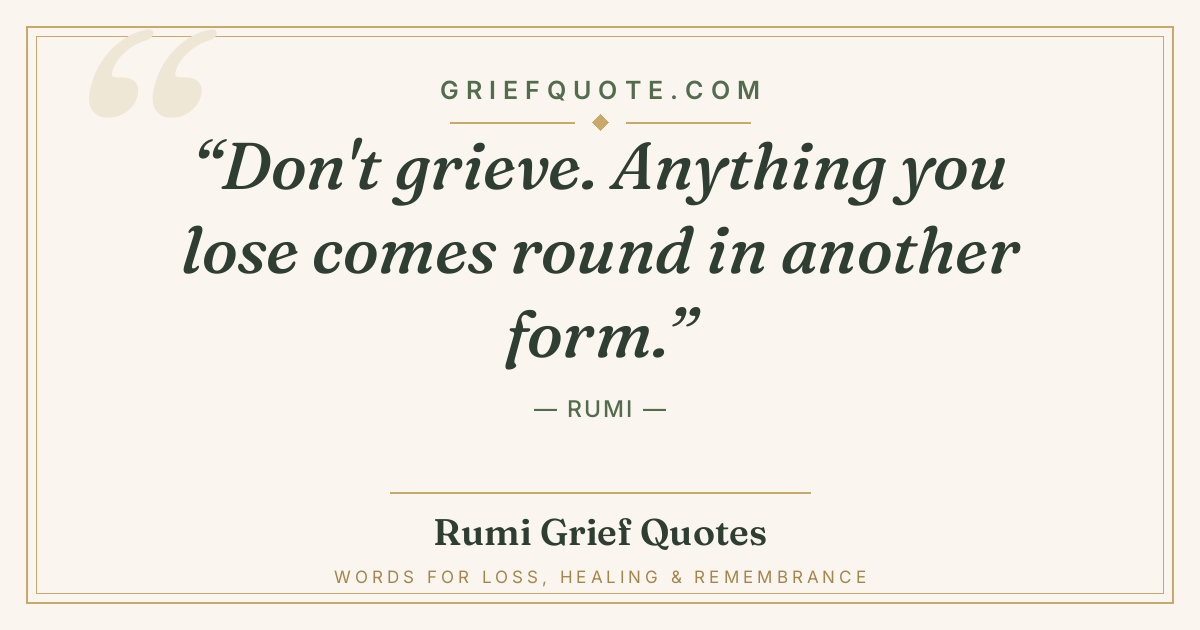
- “Don’t grieve. Anything you lose comes round in another form.”
- “Goodbyes are only for those who love with their eyes. Because for those who love with heart and soul there is no such thing as separation.”
- “I closed my mouth and spoke to you in a hundred silent ways.”
- “Out beyond ideas of wrongdoing and rightdoing, there is a field. I’ll meet you there. When the soul lies down in that grass, the world is too full to talk about.”
Rumi on pain as an opening
- “The wound is the place where the Light enters you.”
- “The cure for pain is in the pain.”
- “What hurts you, blesses you. Darkness is your candle.”
- “These pains you feel are messengers. Listen to them.”
- “Sorrow prepares you for joy. It violently sweeps everything out of your house, so that new joy can find space to enter.”
- “Grief can be the garden of compassion. If you keep your heart open through everything, your pain can become your greatest ally in your life’s search for love and wisdom.”
- “You have to keep breaking your heart until it opens.”
- “Dance, when you’re broken open. Dance, if you’ve torn the bandage off. Dance in the middle of the fighting. Dance in your blood. Dance when you’re perfectly free.”
A necessary honesty about Rumi quotes
Rumi wrote in Persian, eight centuries ago. The English lines above come through translators — most famously Coleman Barks, whose beloved books are openly “versions” made from scholarly translations rather than word-for-word renderings. The spirit is Rumi’s; the exact English words belong partly to the translator, and different translators give you a noticeably different Rumi.
The internet also pins thousands of modern self-help sentences on Rumi that appear nowhere in his work. If a “Rumi quote” sounds like it was written last year for a wellness brand, it probably was. The lines on this page are the ones traceable to his poetry in its standard English versions.
Questions people ask about Rumi and grief
Did Rumi really write about grief?
Constantly — it is the engine of his work. The disappearance of Shams turned a sober scholar into a poet; separation and longing run through the Divan and the Masnavi from beginning to end.
Which Rumi quote suits a funeral or memorial?
“Goodbyes are only for those who love with their eyes…” is read at many funerals and memorials, and “Don’t grieve. Anything you lose comes round in another form” suits cards for someone who shared Rumi’s outlook. For a more traditional room, see our bereavement quotes.
Why do Rumi’s grief quotes feel hopeful instead of sad?
Because for Rumi, separation is never the final fact — the beloved is lost in one form and present in another. Whether or not you share the theology, the emotional logic lands: love does not end at the border of death.
Rumi grieved a vanished friend for the rest of his life, and out of that one loss built a garden the whole world still walks in. Your grief is unlikely to make you a poet. It is allowed, all the same, to become a garden.
Related reading: Uplifting grief quotes · Healing grief quotes · Grief poems and poetry · Quotes about death and grief