Grief Quotes for the Loss of a Husband: For Widows
This page is written for one reader: the woman whose husband has died. Our page for losing a spouse covers widowhood in full — Lewis on Joy, Didion, Parkes — and this page stands beside it, because a widow’s grief has textures of its own: the protector-shaped silence in the house, the name the world suddenly calls you, the future that had his handwriting all over it. Widows are also, statistically and actually, the largest company of mourners there is — and the most likely to be told, kindly and wrongly, that they are “doing so well” while doing nothing of the kind. The words below are chosen for you, each one checked against its source, as every quote on this site is.
Quotes that say what you feel
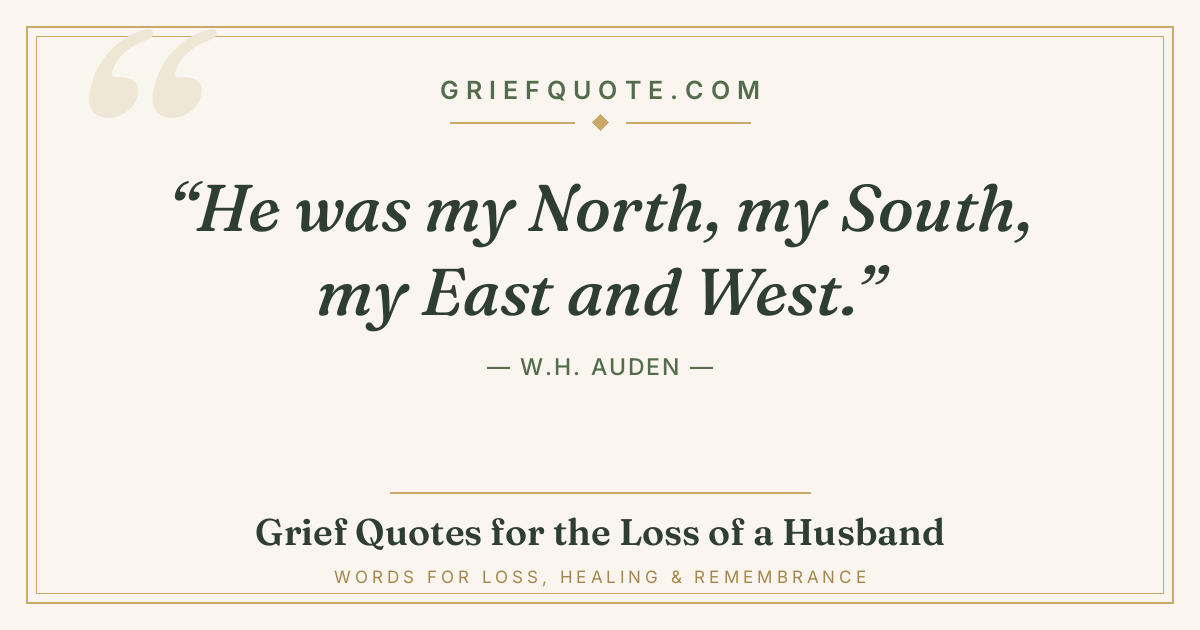
“He was my North, my South, my East and West, my working week and my Sunday rest.” — W.H. Auden, from “Funeral Blues”, written about the loss of the person who was the whole compass. Widows choose it because it refuses to minimise: he was not a feature of the landscape. He was the landscape’s directions. (Shown as a short excerpt, as all poems are on this site.)
“Life changes in the instant. The ordinary instant.” — Joan Didion, opening The Year of Magical Thinking, her memoir of the year after her husband John died at their own dinner table. Every widow knows that instant; Didion’s gift was showing how ordinary it looked from the street.
“Her absence is like the sky” — is Lewis on his wife; the widow’s version of the same truth runs: his absence is the weather of the house now. That sentence is this page’s own, offered without a famous name because it doesn’t need one. Widows describe exactly this: not a room that’s empty, but a climate that’s changed.
“Grief is the price we pay for love.” — Colin Murray Parkes, the bereavement psychiatrist (often credited to Queen Elizabeth II, who was quoting him). An accounting, not a consolation — and many widows say it was the first sentence that respected the size of the transaction.
“Many waters cannot quench love; rivers cannot sweep it away.” — Song of Solomon 8:7. Scripture’s verdict on whether death outranks love, quoted at husbands’ funerals for centuries. More in our Bible verses for grief.
What widows say year one is actually like
The paperwork arrives with the grief. A husband is often the name on the accounts, the policies, the car — and widowhood’s first season is an admin season, conducted in tears at kitchen tables and bank counters. This is not a distraction from your grief; it is one of its cruelest features, and struggling with it is not weakness. The couple-world re-sorts itself. Invitations change shape; some friendships that belonged to the four of you quietly lapse. It is a second, social bereavement, and naming it helps. The second year surprises everyone. Year one runs on shock and tasks; year two, when the world assumes you’re “back”, is for many widows the lonelier one — plan company accordingly, and let people who offer take specific jobs. And the ring question is yours alone: wear it a month, a decade, forever, move it to the other hand or a chain — there is no etiquette with any authority here, only your own hand and your own heart. Our spouse page covers anniversaries and loving again with the same honesty.
What to say to a woman who lost her husband
His name, a memory of the two of them, and presence that survives the funeral:
- “I keep thinking about you and Robert — the way he looked at you across every room like the evening had worked out. He adored you out loud. I’m here at 3pm and 3am; both are fine.”
- “No advice and no ‘stay strong’. Groceries on Saturdays for a while — no need to ask, no need to be cheerful when I knock.”
- Weeks later, the message almost nobody sends: “Still thinking of you and James. His name came up today and we laughed — thought you’d want to know he’s still in our stories.”
Copy-paste versions live on our sympathy card quotes page.
A note on sources
Auden’s poem is shown as a short excerpt; Didion’s line opens her published memoir; Parkes’s line is given to its real author, with the famous misattribution flagged; the “weather of the house” sentence is this site’s own and is presented as such — because on this site, the name under a quote is a promise. The full policy is on our About page.
Keep reading
- Grief Quotes for Losing a Husband or Wife — the full widowhood page
- Grief Quotes for the Loss of a Wife — the companion page, for widowers
- Death Anniversary Quotes — for the hardest date on the calendar
- Missing You Grief Quotes — for the days it still hurts
Frequently asked questions
How long does a widow’s grief last?
There is no honest number — only a shape. The sharp, disorganising grief usually softens gradually over the first one to two years, while anniversaries, his birthday and ordinary songs can restore it at full strength for years. Most widows describe it becoming part of them rather than ending.
Is it normal to be angry at my husband for leaving?
Completely — at the plans abandoned, the paperwork, the empty side of the bed. Anger at the dead is one of widowhood’s most common and least confessed features. It coexists with love; it does not cancel it, and it does not make you disloyal.
What should I do with his things?
Nothing on anyone else’s schedule. Widows range from keeping the wardrobe intact for years to clearing it in a month with a friend and a bottle of wine; both are healthy. The only rule: don’t let anyone rush you into decisions in the first raw weeks that you can’t unmake.
What do I say to a friend who just lost her husband?
His name, one specific memory of them together, one concrete offer — then keep showing up at month three and month nine, when the crowd has gone and the quiet has arrived. That is when widows are loneliest and most remembered friends are made.