Grief Poems & Poetry Quotes: Verses for Funerals & Quiet Days
When prose stops working, poetry still gets through. A poem says the unsayable in a breath, which is why funerals run on them and why the bereaved keep them in phone notes at 3 a.m.
Below are short excerpts from the grief poems people return to most — a few true lines each, with notes on where each one belongs. We quote excerpts rather than whole poems out of respect for the poets; the full texts are easy to find in any poetry collection, and reading one aloud in full is a fine way to spend a quiet evening.
Excerpts for funerals and readings
- “Death is nothing at all. It does not count. I have only slipped away into the next room. Nothing has happened. Everything remains exactly as it was.” — Henry Scott Holland, from his 1910 sermon “Death the King of Terrors”
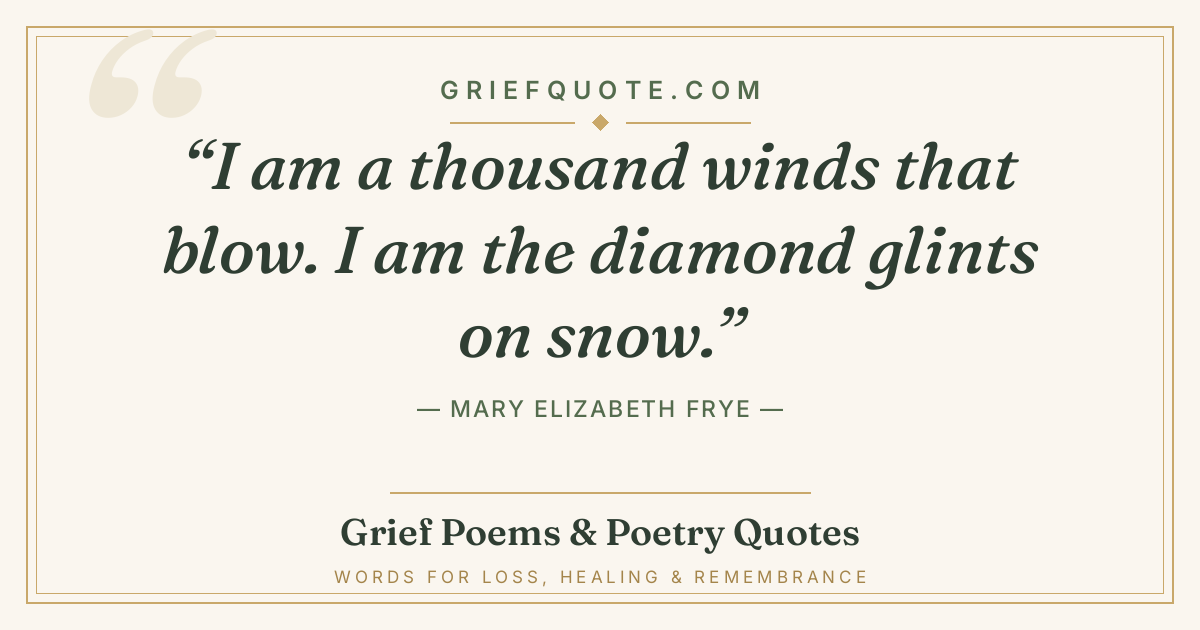
- “Do not stand at my grave and weep. I am not there; I do not sleep. I am a thousand winds that blow. I am the diamond glints on snow.” — Mary Elizabeth Frye, “Do Not Stand at My Grave and Weep”
- “Remember me when I am gone away, gone far away into the silent land; when you can no more hold me by the hand.” — Christina Rossetti, “Remember”
- “I hope to see my Pilot face to face when I have crost the bar.” — Alfred, Lord Tennyson, “Crossing the Bar”
- “Stop all the clocks, cut off the telephone…” — W.H. Auden, “Funeral Blues” (the famous first line of the rawest grief poem in English — read it when politeness feels like lying)
Excerpts for quiet days, just for you
- “If I can stop one heart from breaking, I shall not live in vain; if I can ease one life the aching, or cool one pain…” — Emily Dickinson
- “Tears, idle tears, I know not what they mean, tears from the depth of some divine despair…” — Alfred, Lord Tennyson, “Tears, Idle Tears”
- “Sing no sad songs for me; plant thou no roses at my head, nor shady cypress tree.” — Christina Rossetti, “Song”
- “Someone I loved once gave me a box full of darkness. It took me years to understand that this too, was a gift.” — Mary Oliver
- “And death shall have no dominion.” — Dylan Thomas
Choosing a poem for a funeral
- For reassurance, for a mixed-faith room: Holland’s “Death is nothing at all” is read more than almost any other for a reason — it argues gently that nothing essential has changed.
- For a parent or partner: Rossetti’s “Remember” — tender, and it releases the mourner as much as it holds the dead; later in the poem her point is that being remembered with a smile beats being remembered in pain.
- For raw honesty: Auden. Not every funeral wants comfort; some want the truth with its coat off.
- Length: one to two minutes read aloud is plenty. Choose the poem you can get through without breaking — or appoint the friend with the steady voice. Both are acts of love.
Questions people ask about grief poems
Can I read a poem at a funeral if I am not religious?
Yes. Frye and Holland are read in secular and humanist services constantly, and Tennyson and Rossetti work in any register. Grief poetry belongs to the grieving, not to a denomination.
Why does this page show excerpts instead of full poems?
Because poems are someone’s life’s work — many still in copyright, all deserving more than a copy-paste. A few true lines, honestly credited, tell you which poem you need; the full text takes two minutes to find in a collection or library, and it deserves that small pilgrimage.
What if I cry halfway through reading?
Then the room cries with you, someone squeezes your shoulder, and you finish or you don’t. It has happened at nearly every funeral ever held and has never once ruined one.
Prose explains grief. Poetry keeps it company. Keep one excerpt in your phone for the days that need it — that is not a small thing; that is literature doing its oldest job.
Related reading: Quotes about death and grief · Bereavement quotes · Missing you grief quotes
3 Comments